

Resources to help you do more
CLICK HERE to read the information as a PDF
A major thrust of stewardship of God’s creation is reducing our waste by reusing as many things as possible and recycling (almost) everything else. Here Calvary’s Creation Care group outlines recycling efforts at Calvary and offers everyone detailed information on recycling.
Calvary and its staff employ a range of recycling and composting practices. Calvary contracts with a company to pick up co-mingled hard plastics and cans, contracts with a second company for mixed paper and cardboard (see separate brown dumpster in the corner of the parking lot), takes glass to a drop-off site, and composts yard waste behind the children’s outdoor play area. Plus, parishioners run a drop-off program for plastic bags and other film plastic which is recycled by NexTrek into outdoor benches and other durable products.
When it comes to recycling at your home or apartment, it can be hard to find the details you need. The best 3 websites in the city and surrounding areas are the City of Pittsburgh (www.pittsburghpa.gov/Resident-Services/Trash-Recycling), the Allegheny County website (https://www.alleghenycounty.us/recycling) and the Pennsylvania Resources Council (prc.org)
Below we have collected and organized information for 10 commonly recycled items covering (a) their environmental harm when discarded, (b) how they are recycled, and (c) where and when you can access those services.
In alphabetical order:
Batteries Hazardous household products
Clothing/textiles Light bulbs
Electronics Plastics (hard)
Foam (Styrofoam) Scrap metal
Glass Yard waste
Just scroll down to find your topic.
Questions and suggestions? Email mattmuldoon@msn.com
BATTERIES (household)
● Why Recycle:
○ Many batteries contain heavy metals such as lead, mercury, cadmium, nickel, or silver. If thrown away, they can leak into soil or water and contaminate ecosystems and drinking water. Certain batteries, especially lithium-ion batteries found in electronics, can spark or ignite if crushed in garbage trucks or landfills.
○ Improperly discarded batteries can cause fires in garbage trucks or recycling facilities, creating risks for workers and emergency responders.
○ Recycling keeps them out of normal waste streams. Recycling allows facilities to recover valuable metals such as lithium, cobalt, nickel, and aluminum, which can be reused in new products and batteries.
○ Recycling reduces the need for mining new raw materials, saving energy and reducing pollution associated with manufacturing new batteries.
○ Different battery types require different recycling processes because they contain different chemicals and metals.
○ Automobile batteries (lead acid) are not discussed here but are recycled routinely at service centers and auto parts stores.
● Regional Donation & Recycling Sites:
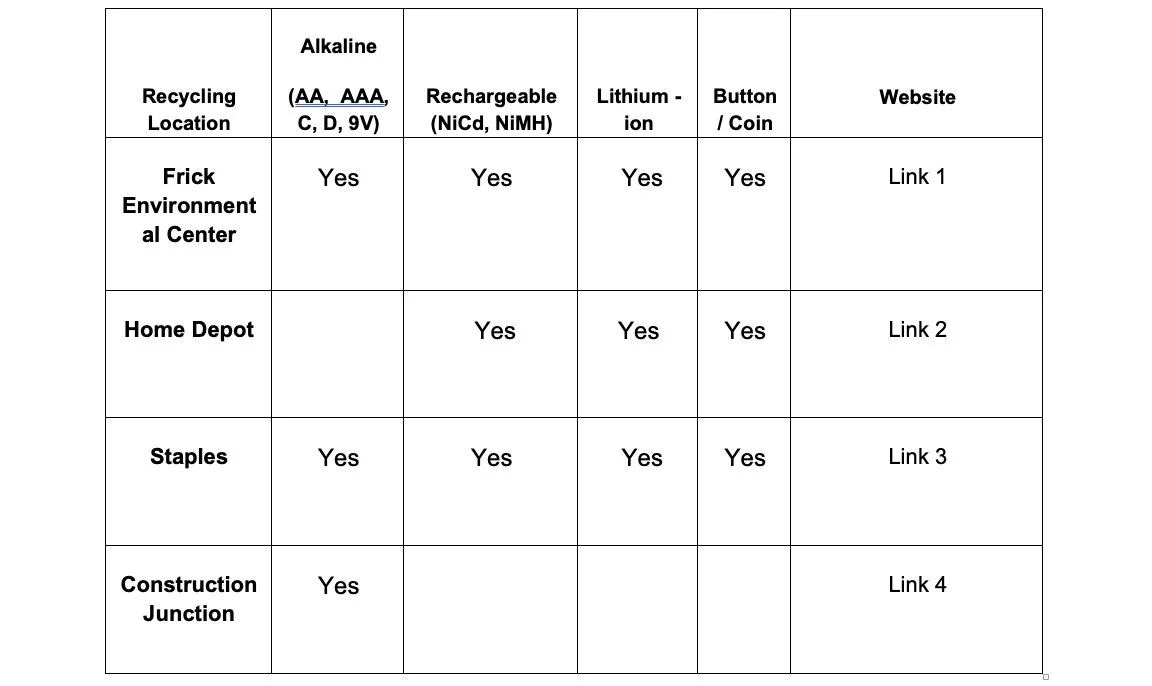
Other Websites:
○ https://prc.org/blog/battery-recycling/
○ https://locations.call2recycle.org/
○ https://pittsburghearthday.org/where-to-recycle-single-use-batteries-in-pittsburgh/
○ https://www.alleghenycounty.us/recycling
+++++++++++++++++++++++++++
CLOTHING (textiles)
● Why Recycle:
○ There is growing awareness that textile production and disposal strain the environment by generating massive landfill waste. Because most current textiles use synthetics (made from oil and related to plastics) they take many decades to decompose and contaminate our waters with microplastics.
○ Textile recycling is complex due to material blends. Therefore, prioritize donations to local partners.
○ For unwearable or a mix of wearable and unwearable clothes, consider drop-off programs, such as Planet Aid or mail-in programs such as Trashie, which ensure 90% of material is diverted from landfills.
● Regional Donation & Recycling Sites:
○ Goodwill of Southwestern PA, multiple locations.
○ Center for Creative Reuse, 214 N. Lexington Avenue. Best for fabric scraps, yarn and sewing notions.
○ University of Pittsburgh Surplus Property, 7500 Thomas Boulevard, Pittsburgh PA 15208, lobby during business hours. Pitt also has 20 sites on campus.
● Online resources:
○ Remains, LLC – Giving textiles a second chance. Remainsllc.com
+++++++++++++++++++++++++++
ELECTRONICS (e-waste)
● Why Recycle:
○ E-waste includes cellphones, desktop and laptop computers, monitors, video games, TVs, scanners/printers and microwaves.
○ These devices contain toxic metals (mercury and lead) and chemicals that contaminate soil, water, and air, especially when dumped.
○ Globally, e‑waste is one of the fastest‑growing waste streams, with only a small fraction formally recycled, leading to widespread pollution and health risks.
● Regional Donation & Recycling Sites:
○ Scheduled drop-off events occur throughout our region under the heading of either “e-waste” or “hard-to-recycle” household items.
○ Some have a flat $5 fee plus an additional fee for TVs and monitors.
● Website resources:
○ The City of Pittsburgh has contracted with Noble Environmental to host drop-off events and locations. Registration is required and costs vary by the type of e-waste or household hazardous chemicals.
○ The PA Resources Council (PRC) maintains a schedule of e-waste recycling events as well as “hard-to-recycle” events.
○ Evolution E-Cycling has multiple locations, including 2235 Mary Street, Pittsburgh PA 15203 on the South Side, provides free recycling of cell phones, LCD monitors, computers, computer components, small appliances, and charges for some items such as microwaves and TVs.
+++++++++++++++++++++++++++
FOAM (for packaging; expanded polystyrene [EPS] or “styrofoam”)
● Why Recycle:
○ Its manufacture consumes lots of petroleum products. It will not biodegrade in landfills where it lasts for generations or becomes microplastics in our water.
○ It is hard to recycle due to high cost. Nonetheless, the material can be densified to make products such as crown molding, decorative frames and building insulation.
○ We all should avoid buying foam products (e.g., cups and plates).
● Regional Donation & Recycling Sites:
○ The Appliance Warehouse on the South Side (20 S. 6th Street, 15203) has free drop-off containers.
● Website resources:
○ The Pennsylvania Resources Council (PRC) collects packaging foam blocks at their seasonal "Hard to Recycle" collection events.
○ The EPS Industry Alliance maintains a searchable map for drop-off locations.
+++++++++++++++++++++++++++.
GLASS
● Why Recycle:
○ Glass is non‑biodegradable, persisting for thousands of years in landfills or natural habitats. It is also heavy to transport and dangerous to handle.
○ Glass is 100% recyclable by relatively simple and efficient methods. It saves 1 ton of carbon dioxide for every 6 tons of recycled container glass.
○ There are several regional glass manufacturing/recycling plants (not distant or overseas). Therefore, glass recycling should be prioritized.
○ Dedicated glass drop-off is preferable to commingled (“single stream”) recycling.
● Regional Donation & Recycling Sites:
○ City residents can discard glass in blue bins for biweekly curbside pick-up.
○ Glass recycling dumpster at Construction Junction, 214 N. Lexington St, 15208
○ City-run East End drop off location(1) on 6814 Hamilton Ave, 15208
○ Check each location for days and times.
● Website resources:
○ City 20 regional drop off locations on Pennsylvania Resources Council (PRC) website.
○ Earth911.com maintains a searchable database of drop-off locations for many types of recyclable items based on your zip code.
+++++++++++++++++++++++++++
HOUSEHOLD CHEMICALS/HAZARDOUS WASTE
● Why Recycle:
○ Household hazardous waste includes unused household products that may explode, catch fire, or be generally harmful to the environment if not properly disposed of. Examples include pesticides, pool chemicals, drain cleaners, chemical solvents and motor oil.
○ Oil-based paints, stains and varnishes are also toxic to the environment and should not be put in the trash.
○ Latex paint is not hazardous. Pour the paint into an absorbent material such as shredded newspaper or kitty litter. Once dried, dispose of in the trash.
● Regional Donation & Recycling Sites:
○ The City of Pittsburgh has contracted with Noble Environmental to host drop-off events at various locations. Registration is required and costs vary by the type of e-waste or household hazardous chemicals.
○ Periodic drop-off events across our region more broadly accept the full range of household hazardous waste. These occur throughout the region at various times of the year. Often, a fee of $5-20 is required. Find the schedule on this page of the PA Resources Council (PRC).
● Website resources:
○ The Pennsylvania Department of Environmental Protection (PA DEP) has an informative webpage.
○ Earth911.com maintains a searchable database of drop-off locations for many types of recyclable items based on your zip code.
+++++++++++++++++++++++++++
Light Bulbs
Why Recycle?
Compact fluorescent lights (CFLs) and fluorescent tubes contain mercury, a very hazardous material. Proper disposal and management offset the risks to humans and other living things. Place in a sealable bag or original box to prevent breakage. If broken, evacuate pets & people; ventilate room 15 minutes; DO NOT vacuum; use stiff paper/cardboard to scoop up fragments or sticky tape to pick up smaller pieces - seal in a glass jar or plastic bag.
Light-emitting diode (LED) lighting is recommended over other lighting modes because it uses 90% less energy than incandescent. These bulbs may contain hazardous materials (aluminum, nickel). Proper disposal/management offset the risks.
Incandescent and halogen bulbs are considered non-toxic.
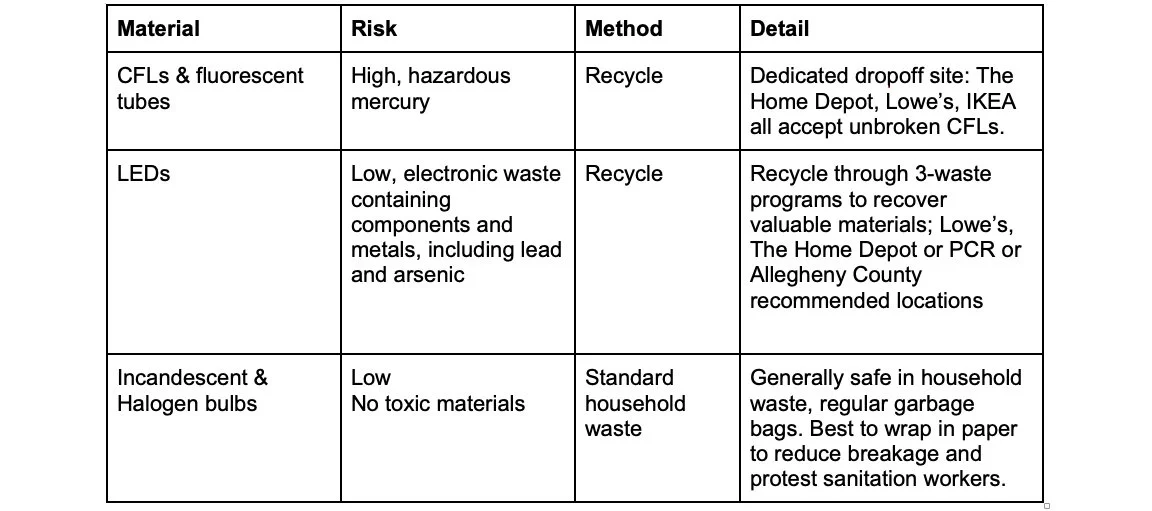
Regional Donation & Recycling Sites:
● No light bulbs are accepted as “glass” for recycling.
● Some local stores have drop-off options for unbroken CFL bulbs (see table) for recycling or safe disposal.
● Generally speaking, light bulbs fall under electronics (e-waste) or under household hazardous waste. The PA Resources Council (PRC) maintains a schedule of e-waste recycling events as well as “hard-to-recycle” events.
● Allegheny County website has a detailed list and locations of drop-off locations for all sorts of recyclable or hazardous products.
Pittsburgh resource
https://cjreuse.org/recycling-services/ Construction Junction
https://www.pittsburghpa.gov/Resident-Services/Trash-Recycling/Drop-Off-Info-Additional-Resources/Recycling-Drop-Off-Locations choose your item of interest
Pennsylvania resource
https://prc.org/workshops-collection-events/
Website resources:
Earth911.com maintains a searchable database of drop-off locations for many types of recyclable items based on your zip code.
+++++++++++++++++++++++++++
PLASTICS (hard, not bags)
● Why Recycle:
● Hard plastics take centuries to completely break down in nature and essentially never in landfills. Left in nature, they shed microplastic particles that are carried in every waterway and appear to cause several health hazards for both humans and animals.
● Plastics are made from petroleum and natural gas. Recycling existing plastics reduces the need to extract new raw materials and saves energy compared to producing plastic from scratch.
● Hard plastics can be recycled into new containers and bottles, outdoor furniture, plastic lumber, storage bins, household items, and automotive parts.
● Regional Donation & Recycling Sites:
● Residents of Pittsburgh can recycle clean plastic bottles, jugs, jars, and tubs under 3 gallons (cottage cheese, yogurt, butter, sour cream) in the City’s curbside pickup. See below for drop-off locations scattered throughout the city. Items not accepted include plastic lids (any kind) clamshell containers (any material), toys, buckets, Solo party cups and plastic lids.
● Live outside the city? Refer to the websites of other municipalities to learn what recycling they provide.
● Live in an apartment and condo building? Likely, your building uses a private recycling company. Check with your landlord or condo association for details.
● Reimagined Recycling (1225 Larimer Ave, 15206) collects, sorts and shreds clean #5 plastic and #4 plastic lids. Their shop also sells detergents and soaps in reusable glass containers as well as products made from recycled plastic!
● Michael Brothers Hauling accepts #1 through #7 plastics (!) at their South Hills and North Hills drop-off locations. The collection bins are available 24/7.
● Website resources:
○ City of Pittsburgh Curbside and Drop-off recycling
Full websites cited above:
+++++++++++++++++++++++++++
SCRAP METAL
Why Recycle?
Metal requires lots of energy and resources to manufacture. It is not biodegradable and often contains small amounts of toxic materials (lead, mercury and cadmium).
Recycling aluminum or copper saves about 90% for the energy needed to make new aluminum or copper, resulting in both cost savings and reductions in greenhouse gas emissions.
Resource conservation
1 ton of recycled steel saves: 2500 lbs of iron ore, 1400 lbs of coalnad 120 lbs of limestone by avoiding original production
Reduce pollution
Using recycled steel decreased air pollution by 86% and water pollution by 76%.
Environmental risks exist with recycling facilities if the pollution risks at the time of recycling are not strictly regulated/enforced.
Airborne particulates (dust) during shredding/melting of scrap metal contain lead, chromium and nickel. Quality air filtrations systems are necessary.
VOC (volatile organic compounds) emissions from grinding metal
Stormwater runoff from outdoor scrap yards washes heavy metals into waterways.
Regional Donation and Recycling Sites:
Within this link are multiple locations within Pittsburgh for management of recycling/waste materials. Not all accept all materials, read for specifics. The Strip District and Construction Junction are the most far reaching.
● Construction Junction https://cjreuse.org/recycling-services/
CJ has very generous operating hours including Sundays. They must inspect the materials you bring before they will accept them. (Other local scrap metal companies may or may not be engaged in good practices.).
Website sources:
● Earth911.com maintains a searchable database of drop-off locations for many types of recyclable items based on your zip code.
+++++++++++++++++++++++++++
YARD WASTE
● Why Recycle:
○ Grass clippings, leaves, pruned or fallen branches, Christmas trees, discarded or dead shrubs and small trees are biodegradable and not hazardous.
○ Ideally, none of these should go into the trash. They will NOT break down in landfills since these areas are sequestered from almost all living organisms.
○ Yard‑waste composting works by letting microorganisms break down leaves, grass, and wooden debris under conditions of oxygen, moisture, and the right carbon‑to‑nitrogen balance. It’s essentially managed decomposition that turns yard waste into a nutrient‑rich soil amendment.
● Regional Donation & Recycling Sites:
The City of Pittsburgh picks up yard waste once each Spring (4/18/26) and once each Fall (11/7/26).
In addition, the City has three drop off sites for yard debris:
○ East End Department of Public Works, 6814 Hamilton Ave (accessible from Dallas Ave) Pittsburgh PA 15208; Monday - Saturday, 8:00 AM - 1:30 PM
○ Hazelwood Department of Public Works, 40 Melancton Street, Pittsburgh PA 15207; Monday - Friday, 8:00 AM - 1:30 PM
○ West End Department of Public Works, 1330 Hassler Street, Pittsburgh PA 15220; Monday - Friday, 8:00 AM - 3:00 PM; Saturday, 7:00 AM - 3:00 PM
● Website resources:
○ City calendar can be accessed here.
○ Grow Pittsburgh has a webpage about compost and composting.
05-06-26